How to Stop Borrowing for Minor Mishaps?
While we often discuss how to find the best 5000 dollar loans, the ultimate goal for financial health is to have your own safety net. An emergency fund is a dedicated savings account for one purpose only: unexpected life events.
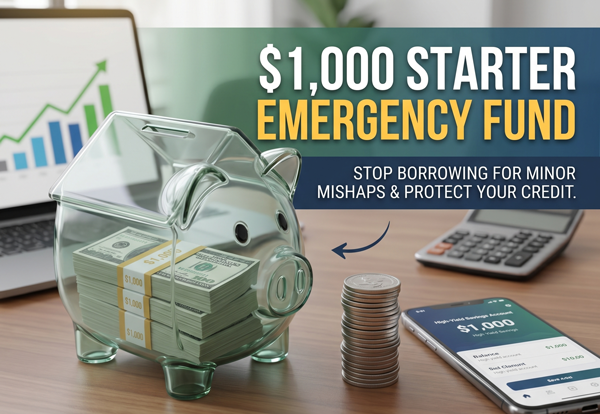
Starting with a $1,000 goal is the most effective way to break the cycle of debt and gain immediate peace of mind.
Why $1,000?
For many, saving a full six months of living expenses feels impossible. However, $1,000 is a "psychological win." It is enough to cover most common "mini-emergencies" without needing to check your credit score or pay interest.
Common $1,000 Emergencies:
- A blown car tire or brake repair.
- An unexpected vet visit.
- A broken refrigerator or microwave.
- A last-minute flight for a family emergency.
How an Emergency Fund Saves You Money on Loans
Having cash on hand changes your relationship with borrowing. If you have $1,000 in the bank:
You Avoid High APRs: You won't have to take out a high-interest payday or installment loan for a small repair.
You Protect Your Credit: You won't have to max out credit cards, which keeps your credit utilization low and helps boost your credit score.
Lower Loan Amounts: If you do eventually need 5000 dollar loans for a major project, you can use your $1,000 to reduce the amount you borrow, saving you hundreds in interest.
5 Steps to Build Your $1,000 Fund Fast
1. The "Found Money" Sweep
Look through your bank statements for the last 30 days. Cancel one subscription you don't use and "sweep" that money into a separate savings account immediately.
2. The 24-Hour Rule
Before any non-essential purchase over $50, wait 24 hours. Often, the urge to spend passes, and you can put that cash toward your $1,000 goal instead.
3. Sell the "Dust Collectors"
Almost everyone has $200–$300 worth of items sitting in a closet or garage. Spend one weekend listing items on Facebook Marketplace or eBay to jumpstart your fund.
4. Direct Deposit "Invisible" Savings
Set up your payroll to automatically send $25 or $50 from every paycheck into a High-Yield Savings Account (HYSA). If you never see the money in your checking account, you won't miss it.
5. Keep it "Out of Sight, Out of Mind"
Your emergency fund should be in a different bank than your daily checking account. This prevents "accidental" spending on non-emergencies like dinner out or new clothes.
Emergency Fund vs. Debt: Which Comes First?
A common question is: "Should I save $1,000 or pay off my 5000 dollar loan first?"
- The Answer: Save the $1,000 first.
- The Reason: If you put every extra penny toward debt and have $0 in savings, the next time your car breaks down, you will be forced to borrow more money, likely at a higher interest rate. The $1,000 acts as a "buffer" that keeps you from sliding backward.
FAQs
Q: Where should I keep my emergency fund?
A: Use a High-Yield Savings Account (HYSA). It's safe, liquid (meaning you can get the cash in 1-2 days), and it earns a small amount of interest.
Q: Is $1,000 really enough?
A: It's a "Starter" fund. Once you have $1,000, you should continue to pay down your high-interest debt, then eventually grow the fund to cover 3–6 months of expenses.
Q: When is it okay to use the money?
A: Only for things that are Unexpected, Urgent, and Necessary. A sale on a new TV is not an emergency!
Conclusion
Building a $1,000 starter emergency fund is the first step toward true financial freedom. It protects your credit score, reduces your reliance on 5000 dollar loans, and provides a sense of security that no credit card can match. Start small, stay consistent, and watch your financial stress disappear.